
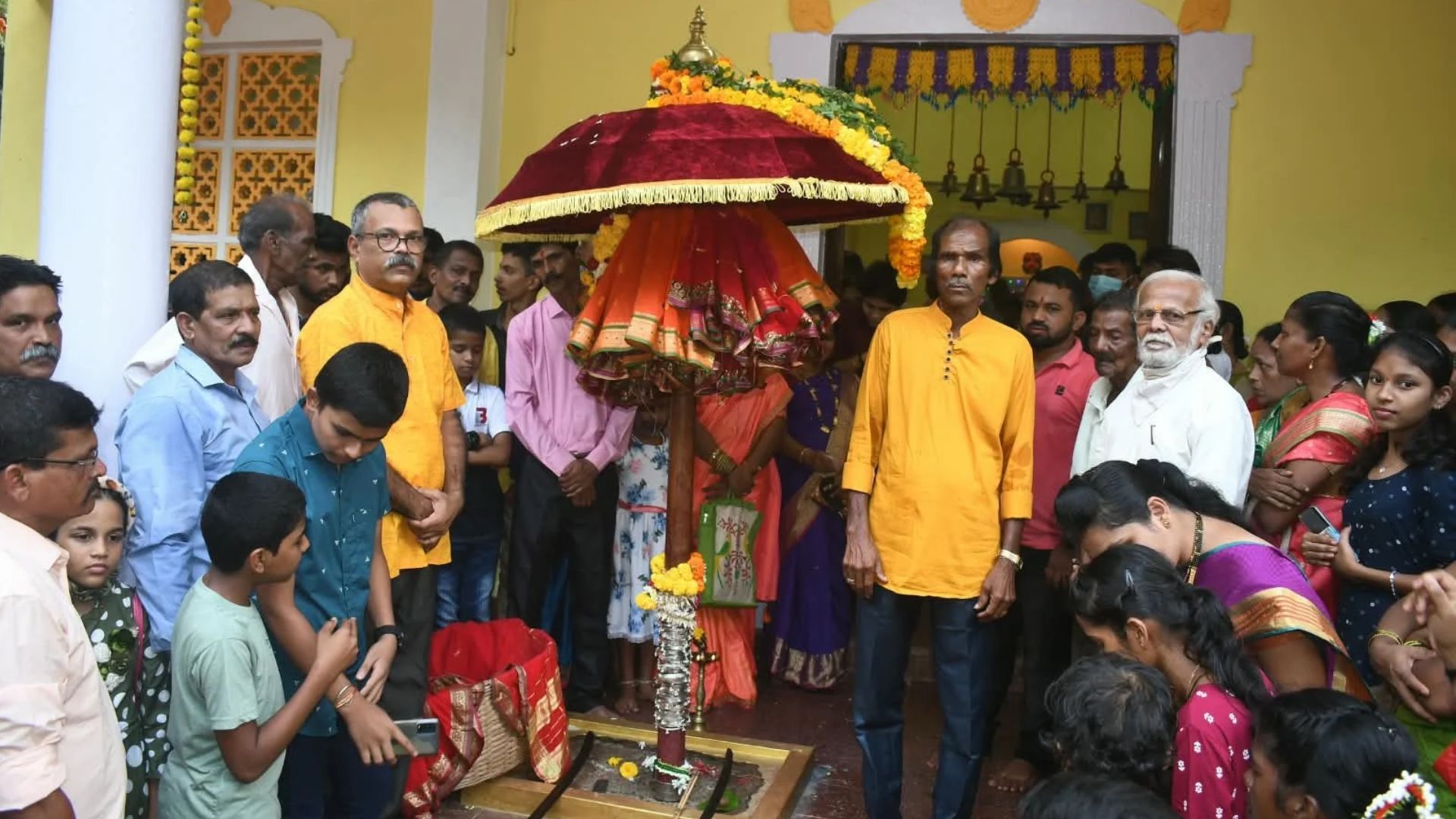
The festival of Dussehra, known as Vijaydashami, is celebrated throughout India with varied traditions that reflect the history of bygone days. And in the villages of Goa, Dussehra has special importance.
Though the practice of human sacrifice is prohibited, in Goa, there are still some rituals performed to express gratitude for the human sacrifices observed in the past.
From Pernem to Canacona, it is customary to perform various rituals to express gratitude for the human sacrifices performed in the past to appease the presiding deity of the village.
IN NARVE, BICHOLIM
The Shantadurga Kankeshwari Temple complex is located in Narve of Bicholim. On the occasion of the Dussehra festival, a person from the Veer family observes a day-long fast. An ash gourd is kept on his abdomen and cut into two halves.
For the betterment of the village and its agro-horticultural crops, a male member of the Veer family sacrificed his head with a sword in the past to appease the deity. After his death, his wife, too, jumped into the burning pyre. In remembrance of their ultimate sacrifice, the villagers installed a memorial showcasing the heads of the husband and wife.
Every year, on the evening of the annual Dussehra festival, seven insignias (tarangas) visit the memorial in front of the temple of Ravalnath-Mahalaxmi.
The ash gourd is cut into two halves in remembrance of the sacrifice in Narve.
IN PORIEM, SATTARI
In Poriem of Sattari, a member of the Naik family is said to have sacrificed himself, in the past, by tying his intestine to the wooden canopy inside the temple of Ravalnath. As a token of remembrance, every year, a person from the Naik family is given the honour of holding the khanjir (sword) when the insignias of Ravalnath, Bhutnath and Pavnai are taken out in the Dussehra procession that starts from Belwada.
In the past, human sacrifice was practised in Goa to appease the deity. The Portuguese government prohibited these practices through laws. Cutting an ash gourd is a substitute for the practice of human sacrifice. This ritual is observed on the occasion of Dussehra to express gratitude to those who sacrificed their lives, and their descendants receive honour.
In Poriem, on the eighth day, goddess Mhalsa visits the Valvont River, marking the beginning of the Dussehra festivities.
Though Saterichi Bhumka is the presiding deity of Poriem, the Rane Sardesai families – scattered across various parts of Goa – visit the temple of Mhalsa at Mhalshekarwada to seek blessings before embarking on any important task. The sanctum sanctorum of Bhumka in the Poriem temple has seven mother goddesses – Santer, Kelbai, Mhalsa, Brahmani, Zogueshwari, Panzon Mauli and Bhumka. However, at Mhalshekarwada, Mhalsa was earlier worshipped in the form of a metal pitcher. When the temple of Mhalsa was renovated in 1989, a sculpture of Ashtabhuja Durga was installed.
Every year, on the evening of the eighth day, the sacred pitcher is taken to the Valvont River to be filled with naturally flowing water. Before that, a rooster is sacrificed on the border of Poriem. Boiled rice, smeared with the rooster's blood, is thrown in all four directions.
On the ninth day, the insignias with palms, representing Rouloba and Bhutoba, along with the mask representing Pavnai, are dressed in sarees at the temple of Ravoulob at Belwada.
Every year, the kalash (sacred pitcher) representing Mhalsa is taken in a procession to the Valvont River. After it is cleaned and filled with water, puja is performed, and it is brought back and kept inside the temple at Mhalshekarwada.
From the day of Dussehra, devotees throng the temple for five days to seek blessings. On the occasion, kangir and khati, two war weapons that are listed as affiliate deities, are worshipped.
IN THE SANVORDEKAR FAMILY
The Dussehra festival celebrated at the ancestral house of the Sanvordekar joint family expresses gratitude to the fertility of Mother Earth and of women.
Situated on the banks of the Zuari River at Madhalawada, in Sanvordem of Sanguem, this almost 250-year-old ancestral house celebrates the festival of Navratri for nine nights, culminating on the day of Vijayadashami. Most of the rites and rituals observed by the family express gratitude to the fertility of Mother Earth as well as womanhood.
Though the members of this huge joint family are scattered across various parts of Goa, other parts of India, and abroad, the majority of them make it a point to attend the festival of Ganesh Chaturthi. However, during the Navratri and Dussehra festivals, the rituals and practices observed showcase respect for fertility.
The ancestral house of the Sanvordekars, with its four top floors and 88 rooms, comes alive during major festive occasions. On the first day of Navratri, the pitcher filled with water is worshipped, along with nine food grains that are sown in clay in the sanctum sanctorum. A new garland of flowers is offered every day. On the ninth day, in the evening, these sprouted grains are given to all the women of the family.
Rice, wheat, red lentils, green gram, black sesame seeds, white peas, horse gram, Bengal gram, and black gram are the nine varieties of food grains used in the ritual of Ruzavan.
The ancestral house has, so far, served eleven generations of the Sanvordekar joint family. The eldest male of the family worships the married daughters, suvasinis, and the young girls who have not yet attained puberty, kumarikas, by washing their feet and offering them flowers, gifts, and vegetarian recipes.
The eulogies of Goddess Shantadurga are sung by the family members. The ten-day-long festivities conclude on the day of Dussehra by observing a variety of rituals and practices deeply rooted in the agricultural heritage.
As per tradition, the house of the Sanvordekars was built around 1740 and has observed the celebration of Navratri for ages. This heritage ancestral house, with its four courtyards and intricately carved wooden pillars, displays the rich and varied socio-cultural traditions that have been inherited through generations.
IN SURLA, BICHOLIM
The Mallikarjun Temple of Surla in Bicholim still remembers the agro-history inherited by the village over many generations.
Every year, Dussehra is celebrated with numerous rituals related to the agricultural and horticultural heritage of the land. Before the onset of iron ore mining, Surla was predominantly an agro-horticultural village known for paddy, millet, and horticultural crops irrigated by the perennial stream Vhavati, originating in the forests of Velguem.
However, with haphazard mining activities, many agricultural and horticultural fields have been heavily silted, and this has badly affected productivity, thereby forcing the farming community to give up their traditional occupations.
In the past, Surla village, with its 12 hamlets, was known for its rich and varied agro-biodiversity. We cultivated paddy during the rainy and winter seasons. Surla was a self-sufficient village. After the immersion of the Ganesh idol, they were involved in doing Vaigan (autumn-season agriculture). In order to get a good yield, the ancestors invoked the god Mallikarjun on the occasion of Dussehra.
Villagers presently residing in Surla, Ghadiwada, came with the deity Mallikarjun from Canacona to Surla in Bicholim. As Mallikarjun freed the villagers from the terror of Betal, the village deity Siddheshwar offered him a place of significance in Surla. Dussehra of Mallikarjun has been worshipped and celebrated to get blessings for the family and agriculture.
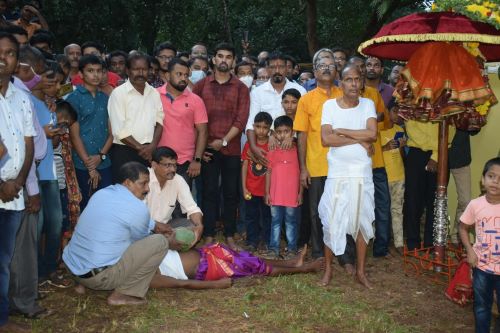
Earlier, during Dasara, there was a tradition of human sacrifice, which has today been replaced by sacrificing an ash gourd (kuvalo) on the abdomen of the devotee with a sword. The five swords that are worshipped in the sanctum sanctorum of the Mallikarjun Temple are brought out in a procession, along with the insignia (tarang) of Mallikarjun, to the tune of the dhol. After blessing the devotees, the insignia of Mallikarjun visits the temples of Siddheshwar, Navdurga, and Siyadev.
The rituals and practices followed on the occasion of Dussehra and during the nine days and nights of Navratri in various parts of Goa showcase the history and heritage of the area.
The author is an environmentalist working for the protection and conservation of wildlife in Goa and border areas
Comments (0)
Please login to post a comment.
No comments yet. Be the first to comment!