
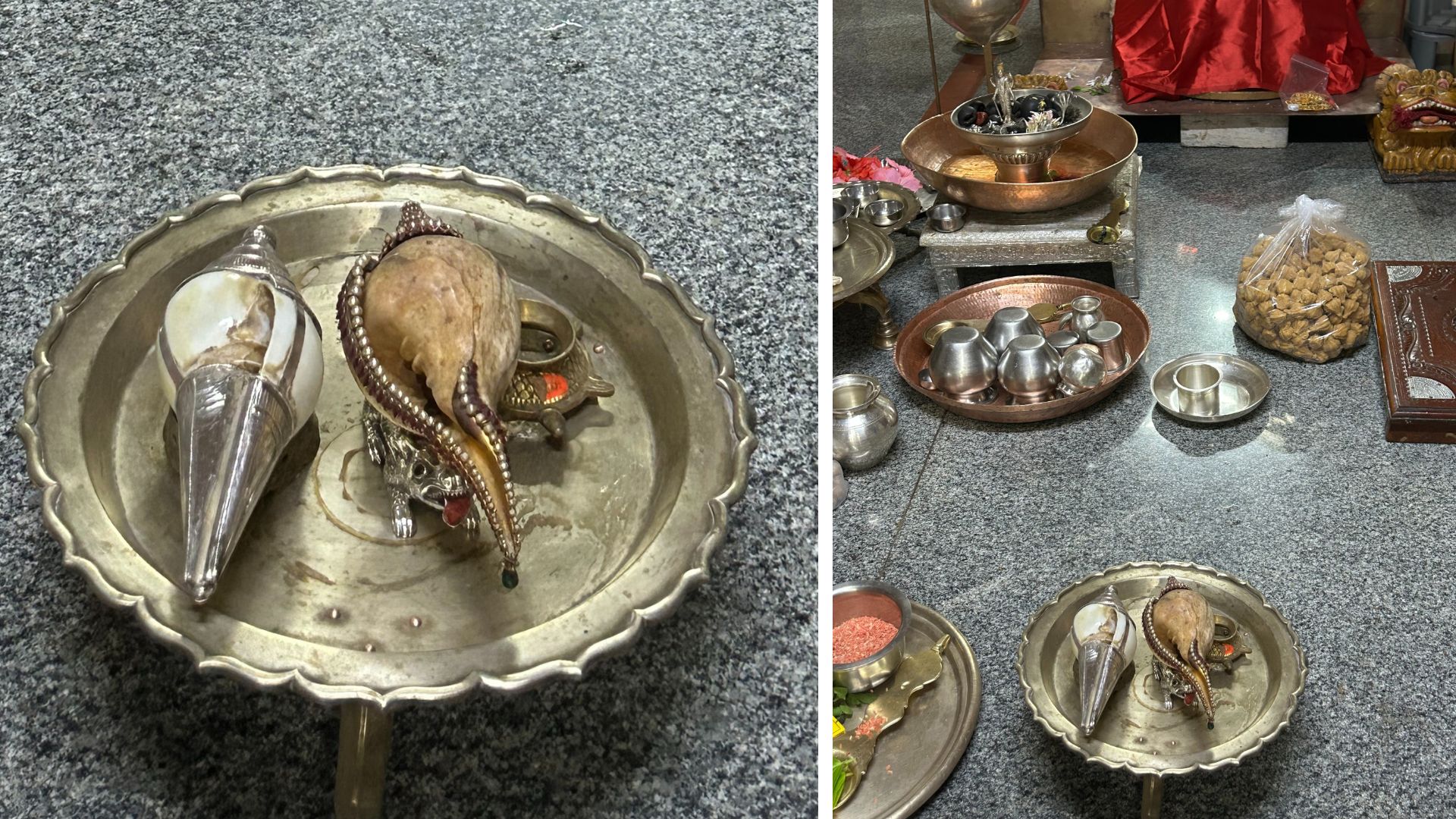
Ganesh Chaturthi is celebrated with great fervour across Goa, and in Panjim, the celebrations extend well beyond the main festival — most notably at the historic Mhamai Kamat residence. A highlight of these extended festivities is the revered shankh (conch), which draws devotees and curious visitors from far and wide.
Adorned with pearls and encrusted with gold and rubies, this rare and sacred conch is displayed for public veneration only on the occasion of Anant Chaturdashi, and at no other time of the year.
DESTINY AT WORK
The story behind the famed shank is an interesting one, having come into the family’s possession over a hundred years ago — almost as if guided by destiny.
“The Mhamai Kamat family had long been engaged in the large-scale export of Balaghat textiles to Portugal. From there, the fabric was re-exported to England, France, Russia, Italy, Holland (now the Netherlands) and the US. With the opening of cotton trade to Brazil, the family became major exporters of the commodity to the South American country in 1770,” explains Dr Shankar Mhamai Kamat, former Director of Archives, Goa.
In light of the family's trading business at the time, their house in Panjim was strategically designed to facilitate their commercial activities, taking into account the surrounding landscape.
“Back in the 1800s, the topography of the area around the house was far different from what we see today, which is evident from a photograph, dated 1888. For instance, there was no Dayanand Bandodkar Marg in Panjim at the time,” shares hands-on historian, Sanjeev Sardesai.
“Next to the (old) Secretariat building (Adil Shah Palace), there used to be a bundh (a kind of bridge or path) where boats would dock to load and unload their goods. Their ballasts were filled with shells, which would be offloaded before loading goods onboard,” explains Sardesai.
Built in 1750, the house of Mhamai Kamat — known as ‘Camotim Mamay’ back in those days — was located next to the Secretariat, which served as the administrative headquarters of the Portuguese. And, the trading family had frequent interactions with Portuguese officials due to the nature of their business, he continues.
During one such visit to the Secretariat, a senior member of the Mhamai Kamat household noticed an unusual conch placed on the desk of a Portuguese official, merely serving the mundane purpose of a paperweight. The elderly man immediately recognised it as something rare, and requested the official’s permission to take it home.
The official obliged, seeing no religious value in the conch, and also because of his cordial relationship with the Mhamai Kamat family, shares Sardesai.
DETAILS, DETAILS
What made this particular shank unusual was that it was right-sided, whereas the average conch is typically left-sided — referring to the direction in which the shell coils and opens. Right-sided conches (dakshinavarti or valampuri shankh) are rare and regarded as highly auspicious in Hindu tradition.
In contrast, left-sided conches (vamavarti) are a common occurrence and are generally less favoured in religious rituals.
The shank has remained in the Mhamai Kamat home ever since then, and holds special prominence during the annual Anant Chaturdashi celebrations, which is observed eleven days after Ganesh Chaturthi. First held at their residence in 1890, the celebration now draws around 800 to 1,000 devotees each year.
Interestingly, Anant Chaturdashi is the only time of the year when the sacred shank is kept open for public veneration. After the celebrations conclude, it is reverently placed back in a safe place in the home, where it is preserved alongside the idol of Lord Anant, to be opened only the following year.
Comments (0)
Please login to post a comment.
No comments yet. Be the first to comment!