
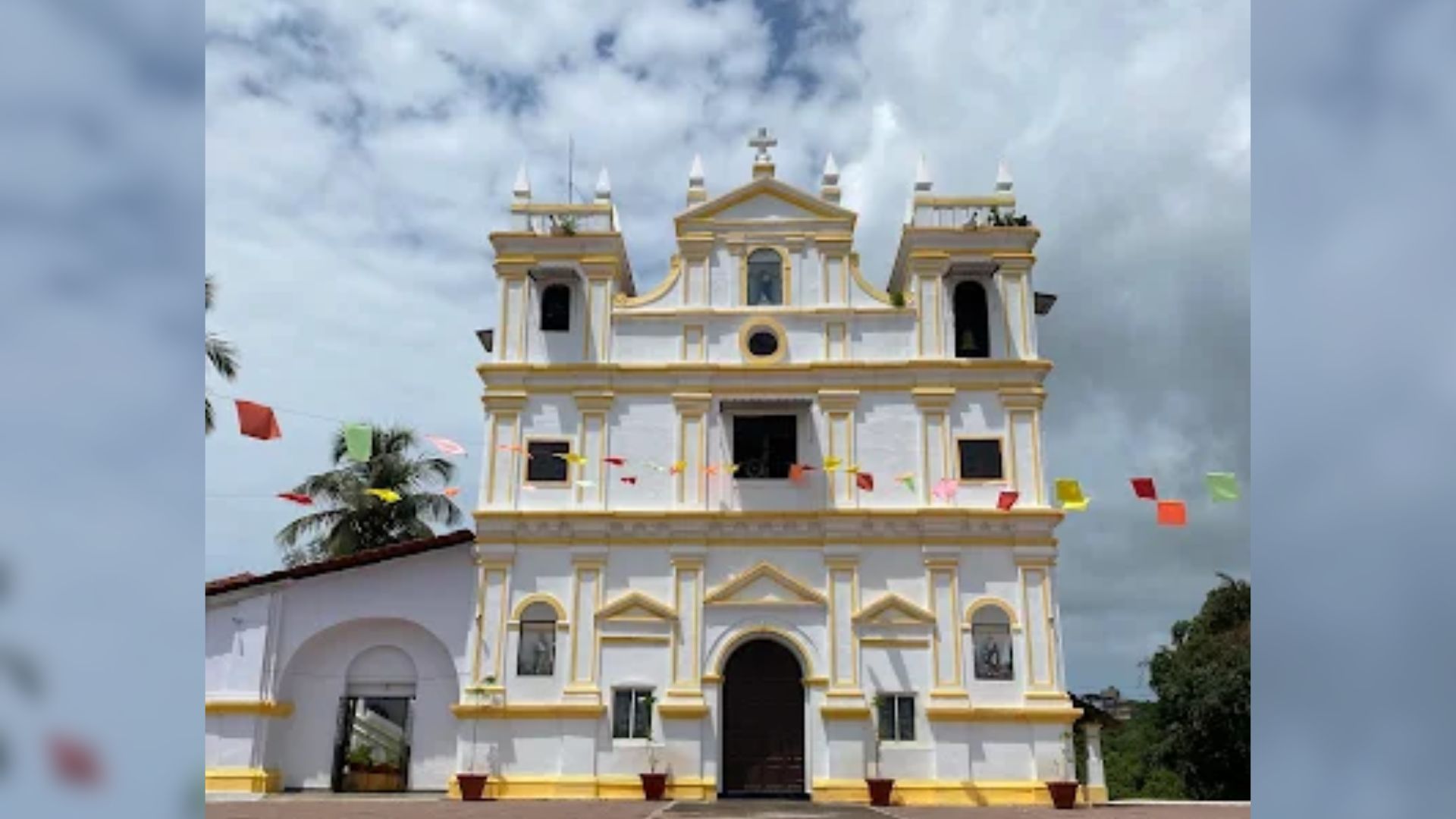
Perched atop a serene hillock, the age-old church of Curca village stands like a sentinel, commanding a majestic view of the surrounding countryside. From this lofty vantage point, one can take in the criss-crossing rivulets, shimmering salt pans, lush green fields, and the quaint villages of Santana de Talaulim, Batim, Goa Velha and Siridao.
Located in Tiswadi taluka, the church is a familiar sight to those travelling along the Bambolim-Batim road via Curca or the Panjim-Siridao route.
For years, this hilltop church would catch my eye, quietly stirring curiosity. Finally, I decided to visit the place during its most important celebration — the annual feast of Our Lady of the Rosary, which is held on 7 October or the Sunday following it.
This year, the feast was celebrated on 12 October. This feast is part of a centuries-old tradition in Curca, and visiting it offered not just a spiritual experience, but an insight into the village’s rich heritage.
ABOUT THE CHURCH
The foundation stone of the church was laid in February 1646 by Archbishop D Fr Francisco dos Mártires, and the first mass was celebrated on 29 June 1650, during the tenure of Viceroy D Filipe Mascarenhas.
The church was constructed by Dom Manoel Lobo da Silveira, a Portuguese fidalgo (nobleman), and continues to stand as a testimony to the architectural and religious legacy of that era.
On the inside, the church features four altars. The main altar is dedicated to Our Lady of the Rosary, while the altar to the left of the transept honours Our Lady of Remedios, considered the privileged altar.
On the right side is the altar of São João Batista (St John the Baptist), and to the left, upon entering, is that of the Sacred Heart of Jesus (Sagrado Coração de Jesus).
According to the Anuário da Arquidiocese de Goa (by Mons Gomes Catão), the parish also has two chapels dedicated to Santa Cruz, where mass is celebrated per modum actus (on special occasions).
FLORAL FESTIVE TRADITIONS
Locally, the feast is known as Rosachem Fest, or ‘Feast of Marigolds’, named after the golden-yellow garlands offered by devotees. Marigolds, known as rosam in Konkani, lend the festival not only a name, but also its colour, fragrance and identity.
During the procession, which wound along the road encircling the church, the parish priest requested the devotees to avoid carrying garlands, as these made the charol (bearing the statue of Our Lady) very heavy and thus difficult for the confreres to carry. Curious about this, I asked the sacristan why the priest made such a request.
He explained that it was customary for devotees — including those from neighbouring villages, such as Batim — to take the garlands home, especially if they had made a vow. These garlands would then be placed on the cross in front of their houses, and a prayer or litany would be recited. This explains why the charol becomes so heavy: garlands are placed on top of it, honouring the tradition and spiritual intention of the devotees.
BRINGING COMMUNITIES TOGETHER
The significance of the feast is evident not only in its history, but also in the devotion it inspires. Despite its modest size, the church overflows with people on the feast day, and many masses are held to accommodate the faithful.
What’s even more remarkable is that the majority of Curca’s residents are Hindu — yet, on the feast day, they too join in, trudging up the hillock in long lines to offer candles and garlands of marigolds to Our Lady of the Rosary.
This interfaith participation is taken into due consideration during the festivities, and the statue of Our Lady is placed near one of the side entrances, allowing non-Catholic devotees to pay their respects without disturbing the church’s liturgical services. It is a striking sight — people from all walks of life, united in reverence, standing patiently with offerings in hand.
The feast is preceded by nine days of novenas and salves, during which the statue of Our Lady of the Rosary (holding the Infant Jesus) is removed from her glass enclosure (marked Nossa Senhora do Rosário) and placed in a charol for public veneration.
The statue remains there until the last Sunday of October, when a special mass and procession are held to mark her ceremonial return to the glass case. This year, the ritual took place on Sunday, 26 October.
NOBLE THOUGHTS
Curca was once a village of great importance. It was home to several fidalgos, and its comunidade included families with surnames such as Santos, Cruz, Gonçalves, Cortez, Pereira, Neves e Fernandes, Pires, Mattos, Costa, Almeida and Mellos.
However, it is disheartening to note that many who have emigrated, or shifted away, from Curca no longer return for the feast, nor attend the church services that once formed the heart of the community.
In an era where Goan identity is being actively discussed and debated, maintaining a connection with one's native village is not just sentimental; it is essential. It is perhaps the least we can do to preserve the heritage, traditions and spirit that define us, as Goans.
IN THE NEIGHBOURHOOD
Curca’s neighbouring village, Talaulim, adds another layer to this vibrant cultural fabric. Its church is dedicated to St Anne, the mother of the Blessed Virgin Mary — known locally as Santana, which is derived from the Portuguese word, Santa Ana.
Both villages celebrate their patronal feasts with distinct traditions that reflect their deep-rooted faith and connection with the land, and the local names and customs associated with them.
In Talaulim, the feast of St Anne is popularly known as Toucheachem Fest, or ‘Feast of Cucumbers,’ and devotees offer cucumbers as a sign of faith. In contrast, Curca’s feast of Our Lady of the Rosary is fondly called Rosachem Fest, or ‘Feast of Marigolds’ due to the garlands of marigolds (known as rosam in Konkani) offered by the faithful.
These simple, yet meaningful offerings of cucumbers and marigolds, are more than symbolic. They are a sign of agricultural abundance, community spirit, and the enduring faith of Goa’s Catholics. They also illustrate how universal religious traditions adapt beautifully to local culture, creating a mosaic of deeply personal devotion.
LIVING HERITAGE
Attending the Rosachem Fest is far more than a religious observance. It is a living tradition, one that blends faith, culture and community. It is a moment when the past and present meet on a quiet hill in Curca, where marigolds bloom not just in gardens, but in garlands of devotion carried home with reverence.
In every candle lit, in every garland offered, and in every prayer whispered, the spirit of Nossa Senhora do Rosário continues to thrive, reminding us that the simplest acts of devotion often carry the deepest significance.
Comments (0)
Please login to post a comment.
No comments yet. Be the first to comment!