
On the evening of 16 September, the Seminar Hall at Goa University, Taleigao Plateau was filled to capacity as people from across Goa gathered with a shared purpose: to hear about the uncertain future of their river, the Mandovi — or Mhadei, as it is known locally.
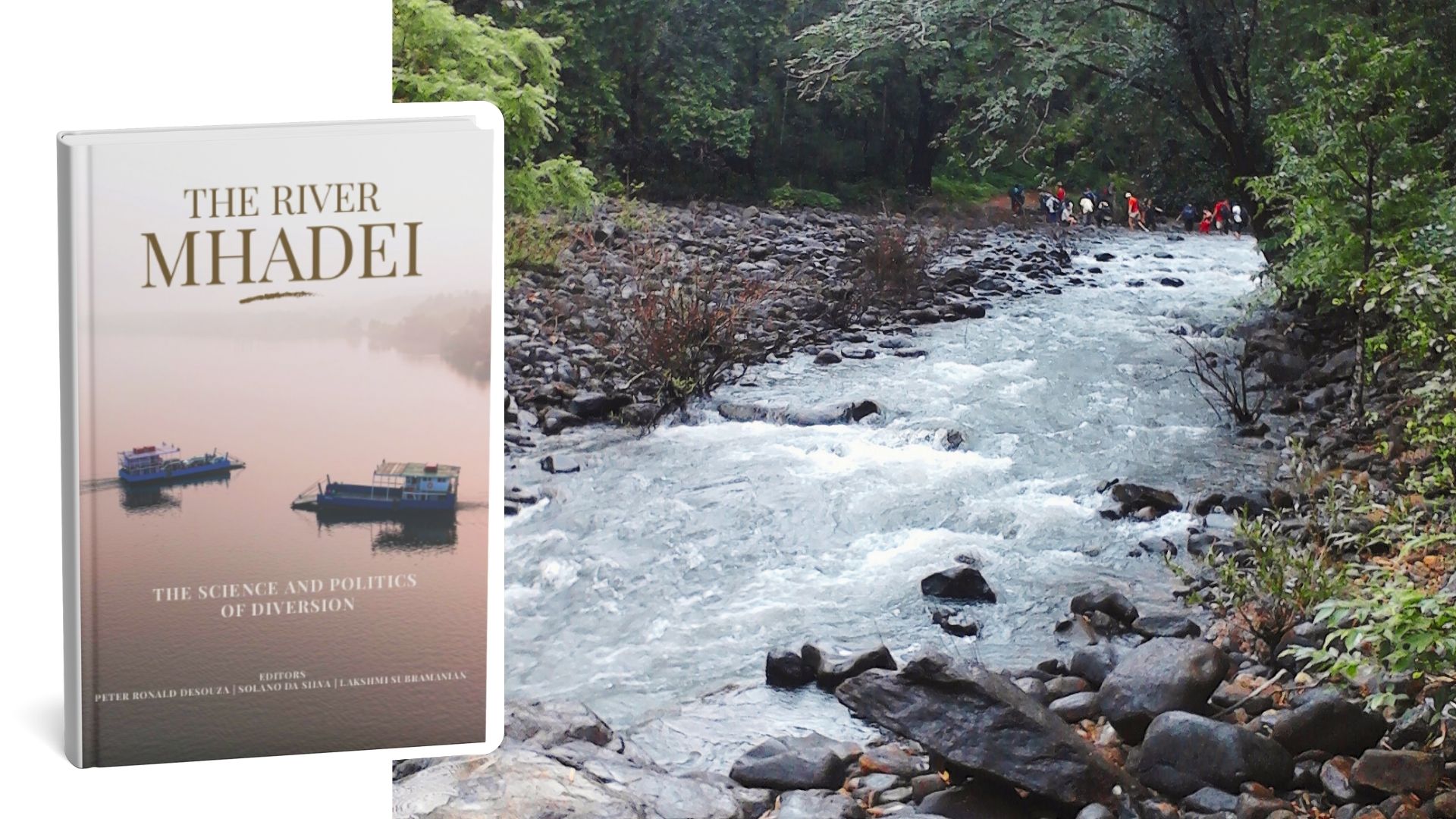
The occasion was the launch of The River Mhadei: The Science and Politics of Diversion, published by Goa 1556 and edited by Peter Ronald deSouza, Solano Da Silva and Lakshmi Subramanian.
The book brings together a series of research articles examining the consequences of the diversion of the Mhadei’s waters.
INSIDE THE BOOK
The book features 18 chapters on the Mhadei, written by scientists, ecologists, legal scholars, historians, planners, journalists, activists and community practitioners, all contributing to an exploration of a pressing environmental dispute.
Peter Ronald deSouza, co-editor of the book, said in his address that there is an urgent need to understand the ecosystem that the river sustains. “We are the trustees of the Mhadei,” he added. “We need to look at the river on an inter-generational level, and include the communities that depend on it.”
He also noted that a river serves as a memory archive, and pointed out that there are 21 laws in place designed to protect it.
MHADEI MATTERS
The chief guest at the book release, Justice (Retd) Dr Ferdino Rebello, outlined the history of the Mahadayi Water Disputes Tribunal, constituted in 2010, which in 2018 allocated 13.4 TMC to Karnataka, 24 TMC to Goa and 1.33 TMC to Maharashtra. He noted that this is only an interim award, due for review after 31 August 2028. He emphasised that comprehensive documentation and rigorous research on the Mhadei are essential.
Justice Rebello also pointed out that the Tribunal has permitted Goa to undertake 59 projects on the river. However, he noted that the state is currently not in a position to provide the necessary water storage to support these projects. He added that these projects would result in the submersion of large areas, with many located within Goa’s wildlife sanctuaries and forested regions.
He emphasised the need for experts to assess the impacts of global warming, rising sea levels, and increased salinity intrusion in the coastal areas of the Mhadei River. He also provided an overview of the river, highlighting how it has been affected by mining waste, casinos, sewage discharge and other human activities.
SHARED VISION
Rajendra Kerkar of Mhadei Bachao Abhiyan, and one of the book’s authors, provided details about the Mhadei River and the Kalsa Bhanduri Nalla project in Karnataka. He noted that the tribunal had permitted the diversion of 3.90 TMC of water from the Mhadei basin to the Malaprabha reservoir. However, the matter is now before the Supreme Court following objections from all three states.
Kerkar stated that in a democracy, water sharing between states should not be a contentious issue. However, in the case of the Mhadei, the situation is different, as it is a very small river, stretching just 111 km, compared to larger rivers such as the Krishna and the Godavari.
“The Inter-State River Water Disputes Act was enacted in 1956, when Goa was still under Portuguese rule. After Goa’s liberation, it became the duty of the state government to inform the Central Government that we do not have a major river. The Krishna River, which rises in Mahabaleshwar, spans one-fifth of India, and the Malaprabha is one of its 25 tributaries. Compared to these large rivers, the Mhadei cannot really be considered a river. Our rivers, like the Mhadei and the Zuari, are more like streams,” he revealed.
He also highlighted the fragile ecology sustained by the river, warning that any disruption could lead to increased salinity, the destruction of agricultural lands, and other adverse impacts.
Sujata Noronha of Bookworm Library, Panjim, spoke about the Nhoi Project, which documented the river stories of 13 communities living along the Mhadei. They were invited to share their memories of the river, their knowledge about it, and their hopes for its future. The project involved 800 people ranging in age from 5 to 83 years.
The event concluded with a screening of the documentary Maa Dei – Mother Goddess, directed by Gasper D’Souza, Shrinivas Ananathanarayanan, and Ethan D’Souza.
Comments (0)
Please login to post a comment.
No comments yet. Be the first to comment!